Country
pays.culture in six chapters
The country you think you know by heart, from the Gauls to the TGV.
The six chapters
The same six, in the same order, for every country: you know what you will learn before you open it.
History
- The foundationsSix lessons on how France was made, from the Gaul of Vercingetorix to the first Capetians.7 lessons
- Jeanne d’Arc before her judgesRouen, 1431: the trial of Jeanne d’Arc, word for word, from the register her judges kept.2 lessons
- Marie CurieTwo Nobel prizes and a method, told in her own words: measure what nobody was looking at.2 lessons
Legends
Language
At the table
Land
Today
Think you know?
Claims about this country. True or false, with the source under each answer.
1 / 5
Roland died at Roncevaux fighting the Saracens.
The dossiers of this country
Free to read: a definition, a timeline, the sources.
- The Dreyfus affair: the facts, the documents, the argumentsThe Dreyfus affair is the judicial and political crisis that arose in France from the conviction, on 22 December 1894, of captain Alfred Dreyfus for spying for Germany. He was innocent and was deported to Devil’s Island; the real author of the incriminating document was shielded, and an officer manufactured another. The Court of Cassation quashed everything on 12 July 1906.
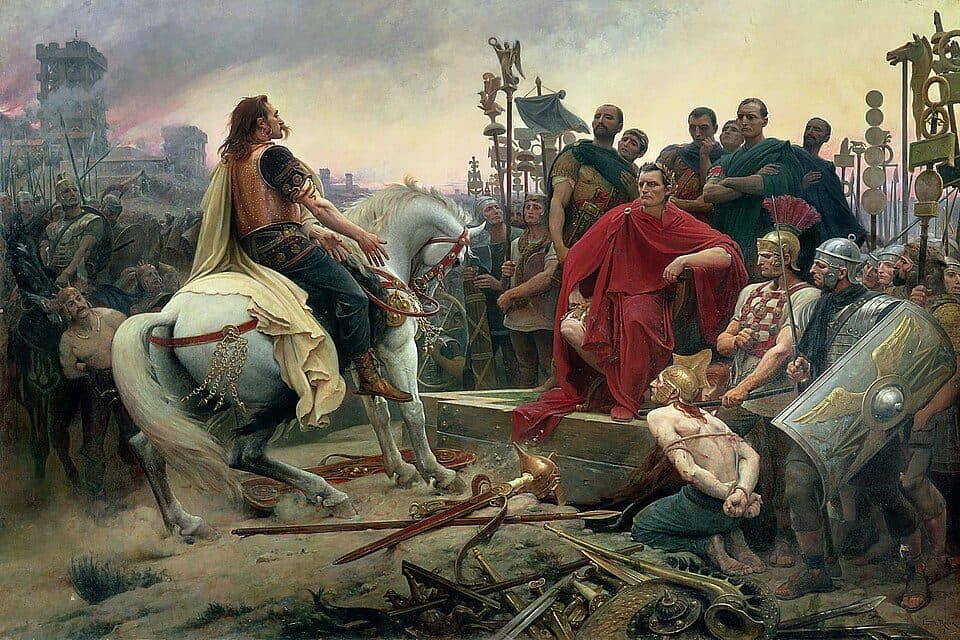
- Alesia: where the siege was, and what was found thereAlesia is the Gallic oppidum where Julius Caesar besieged and captured Vercingetorix in 52 BC, the episode that closes the account of the Gallic War. The site is identified as Mont Auxois, at Alise-Sainte-Reine in the Côte-d’Or, where excavation has recovered both Roman lines of fortification. It became a prosperous Gallo-Roman town and was abandoned in the fifth century.
- Charlemagne: what is known, and who told usCharlemagne (c. 748-814) was king of the Franks from 768, then emperor in the West: on 25 December 800, Pope Leo III crowned him in Rome. He ruled from Aachen over an empire covering today’s France, Germany and northern Italy. Almost everything known about him comes from one book, Einhard’s Life of Charlemagne, written after his death by a man of his own court.
- Charles de Gaulle: what he did, and what is argued overCharles de Gaulle (1890-1970) was a French general and statesman. On 18 June 1940, from London, he called for the war to go on and founded Free France, then led the provisional government until he resigned on 20 January 1946. Voted in by the Assembly on 1 June 1958, he had the Constitution of the Fifth Republic adopted and was president from 8 January 1959 to 28 April 1969.
- Charles Martel: the master of the Franks who was never kingCharles Martel (c. 688-741) was a Frankish leader, the son of the mayor of the palace Pepin. Pushed aside when his father died, he imposed himself by force and governed the Frankish kingdoms in the name of Merovingian kings he chose himself. In 732, between Poitiers and Tours, he beat an army from al-Andalus. He died in 741 without ever having worn a crown.
- Clovis: who he was, and why France claims himClovis (c. 466-511) was a Frankish king. Around 481 he succeeded his father Childeric, eliminated the other Frankish kings, beat Syagrius at Soissons and crushed the Visigoths at Vouillé in 507. Baptised a Catholic at Reims by bishop Remigius, on a date historians still argue over, he died in Paris in 511. Almost everything known about him comes from Gregory of Tours, a century later.
- Daft Punk: what two robots did to discoDaft Punk was a French electronic music duo, formed in Paris in 1993 by Thomas Bangalter and Guy-Manuel de Homem-Christo and dissolved on 22 February 2021. Anonymous from the start and helmeted as robots from 2001, it released four studio albums (Homework, Discovery, Human After All, Random Access Memories) and won six Grammy Awards.
- Gabrielle Chanel: the woman who wove her own legendGabrielle Chanel, known as Coco Chanel, was a French couturière born at Saumur in 1883 and died in Paris in 1971. A milliner on the rue Cambon in 1910, she opened a shop at Deauville in 1912 and a couture house at Biarritz in 1915. Jersey, the little black dress, the N°5 perfume, the tweed suit and the 2.55 bag are her most lasting creations.
- Hugh Capet: an elected king, a dynasty of eight centuriesHugh Capet (c. 941-996), duke of the Franks, was elected king in 987 by the magnates of the kingdom meeting at Senlis, after Louis V, the last Carolingian, died childless. From his father he held Neustria, carved up by principalities, and the duchy of France. By having his son Robert crowned in his own lifetime he founded the Capetian dynasty, which would rule France until 1792.
- Joan of Arc: who she was, and how we knowJoan of Arc (c. 1412-1431) was a girl from Domrémy, in Lorraine, who persuaded Charles VII to send her to Orléans, where the siege was lifted on 8 May 1429, and who then led him to be crowned at Reims. Captured at Compiègne in 1430 and tried for heresy by a Church court at Rouen, she was burned on 30 May 1431 and cleared in 1456.
- Louis XIV: 72 years on the throne, and what he never saidLouis XIV (1638-1715) became king of France and Navarre at four and a half, governed in his own name from 1661, and died on 1 September 1715 after seventy-two years on the throne. He moved the Court to Versailles on 6 May 1682, revoked the Edict of Nantes in 1685, and left the throne to his five-year-old great-grandson Louis XV.
- Marie Curie: two Nobels, and the method behind themMarie Curie, born Maria Skłodowska in Warsaw in 1867, was a Polish-born French physicist and chemist. She named radioactivity, discovered polonium and radium with Pierre Curie in 1898, isolated radium, and received two Nobel Prizes: physics in 1903, with Pierre Curie and Henri Becquerel, chemistry in 1911, alone. She died on 4 July 1934.
- Napoleon: what he founded, what he restoredNapoleon Bonaparte (1769-1821) was a Corsican general who became First Consul through the coup of 18-19 Brumaire, Year VIII, then Emperor of the French in 1804. His regime gave France institutions still standing (the Banque de France, the prefects, the lycées, the Civil Code) and restored slavery in the colonies on 20 May 1802. Beaten at Waterloo, he died on Saint Helena.
- The French Revolution: what is known, what is arguedThe French Revolution is the period that, from 1789 to 1799, abolished absolute monarchy and the society of orders in France. It opens with the Estates General of 5 May 1789, proclaims the Declaration of the Rights of Man and of the Citizen on 26 August 1789, abolishes the monarchy on 21 September 1792, and ends with the coup of 18 Brumaire, on 9 November 1799.
- Vercingetorix: what is really known about himVercingetorix was an Arvernian nobleman who in 52 BC led the revolt of the Gallic peoples against Julius Caesar. He drove Caesar back at Gergovia, then surrendered the same year at Alesia. One ancient author alone, Cassius Dio, says he was later displayed at a triumph and put to death. No Gallic account survives: everything comes from the Romans.
How these lessons are written
Each lesson starts from first-hand sources: Wikisource, Gallica, Persée, archives, museums and institutes. A fact without a source does not get written, and every lesson lists its own as direct links.
The rhythm
A lesson is five minutes of cards and four questions. Those questions then come back the next day, then at 3, 7, 21 and 60 days, and that return is what makes it stick. One a day is enough, and you can do several in a row.