Path · France
The foundations
From Vercingetorix to Hugh Capet
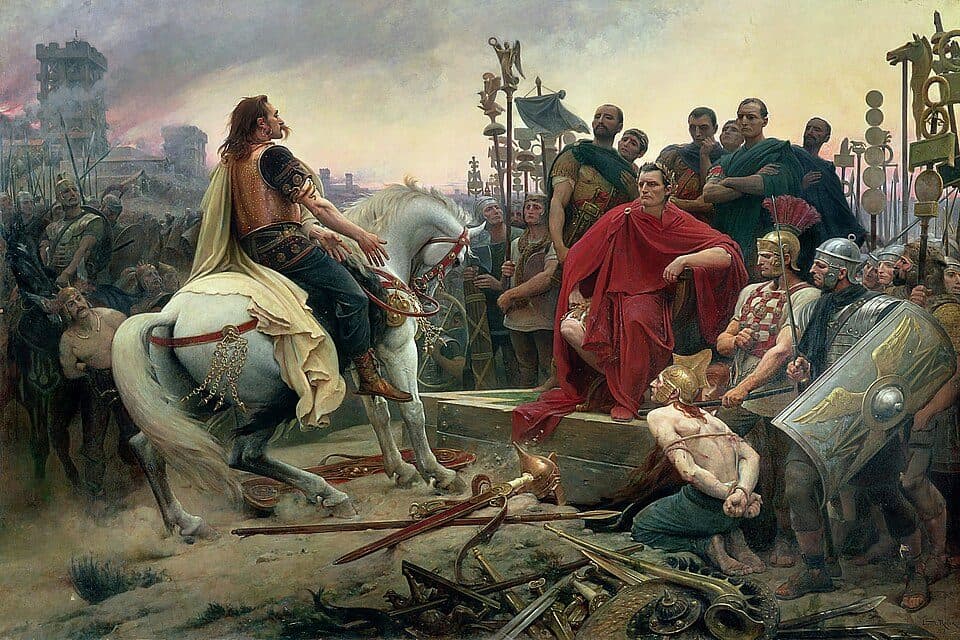
This chapter is about the making of a country: a Gaul that was never a nation, a conquest written up by the winner, kingdoms that came apart, and a dynasty that settled in for eight centuries. Every lesson starts from the sources of the time — Caesar, the chroniclers, the archaeology — and says what is known, what is guessed, and what was invented long afterwards.
Context first
This one opens without an account, and it is read before the lessons.
- The place
- The era
- The people
The lessons in this path
- 1Alésia, the end of free GaulAlésia is a defeat the victor dispatched in a single sentence — and that France turned into a national myth nineteen centuries later.5 min
- 2Roman Gaul, five centuries under our feetBetween Vercingetorix and Clovis lie five centuries of towns, roads and citizens. Roman Gaul never vanished: it is under your feet, and every building site brings a piece of it back up.5 min
- 3Clovis, the baptism nobody can put a year onClovis’s baptism comes to us from a bishop born twenty-eight years after his death. One contemporary gives the day, Christmas. The year, nobody. France made it its birth certificate anyway.6 min
- 4Poitiers 732, the battle that grew in the tellingPoitiers 732: the nearest chronicle runs to fifteen lines, with no date, no place, no figures. The 375,000 dead, the Europe saved, the painting at Versailles? All of it came afterwards.5 min
- 5Charlemagne, the emperor who was learning to writeCharlemagne never really learned to write. But he made a whole empire write — laws, poems, gospels — in a script so legible that our lower-case letters still descend from it.6 min
- 6Hugh Capet, the king nobody noticedIn 987 the magnates elect Duke Hugh: the throne “is not acquired by hereditary right”. At Christmas, he has his son crowned. Nobody notices — a dynasty has just begun.5 min
How these lessons are written
Each lesson starts from a brief and from period sources — Wikisource, Gallica, Persée, archives and museum websites. A human verifies every date, every figure and every quote in the original source before publication, and signs it. The sources are listed under each lesson, linked directly.
The rhythm
One five-minute lesson a day, four questions at the end, then a review the next day, at three days, seven, twenty-one and sixty. It is that spaced return that makes what you read stay.